
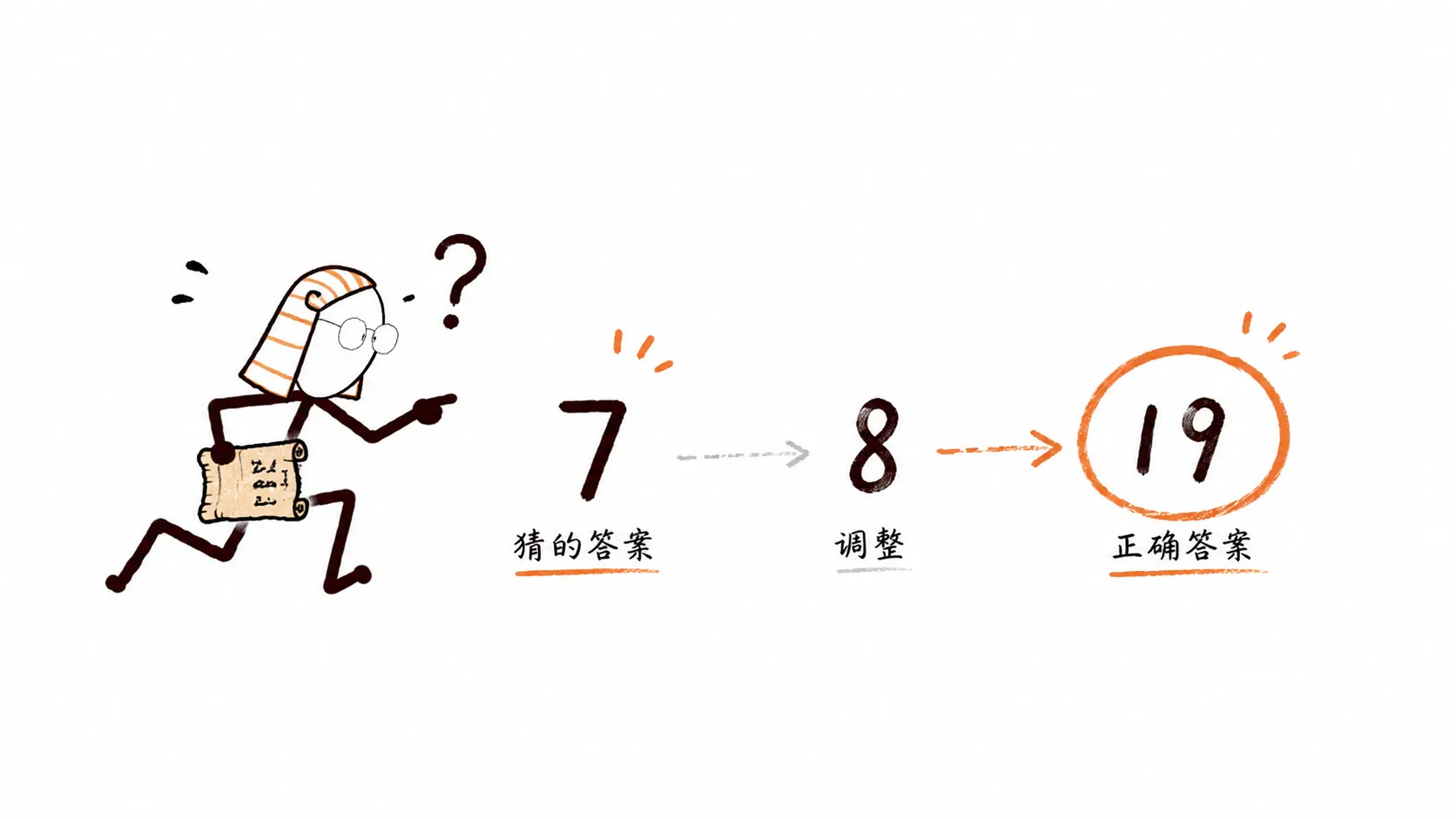
Why Did Ancient Egyptians Like to Guess the Answer First? — The Mathematical Idea Behind the Method of False Position
Today, if someone asked you:
A number, plus one-seventh of itself, equals 19. What is the number?
Most people would instinctively write:
Then they would move terms around and simplify step by step until they reached the answer. There is almost nothing to hesitate over, because we are already accustomed to thinking in terms of equations.
However, if you gave the same problem to an ancient Egyptian scribe four thousand years ago, he might look at you in confusion—not because he could not calculate, but because in his world, there was no such thing as an “equation.”
Ancient Egyptians Had Neither Unknowns Nor an Equals Sign#
When modern mathematics solves a problem, we usually begin by setting up an equation.
For example:
A number, plus one-seventh of itself, equals 19.
Today, we can write it very naturally as:
This expression actually contains three concepts that seem completely obvious to us today:
- using a symbol, such as , to represent an unknown quantity;
- using an equals sign to indicate that two quantities are equal;
- treating the entire equation as an object that can be continuously transformed and manipulated.
However, none of these three concepts had yet appeared in ancient Egyptian mathematics. They had no unknowns, no equals sign, and no algebra.
So how did they solve problems like this?
The answer is a method that later came to be known as the Method of False Position.
Instead of Setting Up an Equation, Guess an Answer First#
The idea behind the Method of False Position is very simple: if you do not know the correct answer, guess one first.
For example, consider the problem we just saw:
A number, plus one-seventh of itself, equals 19.
The ancient Egyptians would typically not try to find the actual answer immediately. Instead, they would choose a number that was easy to calculate with.
For example:
Why choose 7?
Because:
That makes the calculation extremely convenient.
So they could immediately obtain:
Of course, they knew that 8 was not the answer the problem was asking for. What they actually needed was 19.
Then, Let the Answer “Grow”#
The ancient Egyptians then looked more closely at what they had just calculated.
They had obtained:
but the target was:
They noticed that:
So if the result 8 could be scaled up to 19 by multiplying it by , then the original guess, 7, could be multiplied by the same factor:
And the problem was solved.
Throughout the entire process, they never set up an equation, moved terms from one side to the other, simplified an algebraic expression, or even used the concept of an “unknown.”
They simply used proportional relationships to gradually correct an incorrect answer until it became the correct one.
Why Is It Called the “Method of False Position”?#
In modern English, this method is usually called:
False Position
or:
Regula Falsi
Literally translated, it means:
False position.
The name sounds a little strange. But it describes the most important step in the entire method:
The first step is to deliberately place an incorrect answer in position.
That incorrect answer is not a failure. It is simply a starting point. What really matters is the process of correcting it afterward.
The Chinese name for the method, “Shi Wei Fa” (试位法), makes this idea particularly intuitive:
- “Shi” (试) means to try or make an initial attempt.
- “Wei” (位) means to place a number in that position.
If the initial number is not correct, it can be adjusted and refined. This is also one of the earliest systematic approaches to approximate problem solving in human history.
Is It Really Just “Guessing”?#
When modern people first encounter the Method of False Position, they often think:
Isn’t this just picking a number at random?
In fact, it is not. The real key is not simply to guess, but to guess a number that is easy to calculate with.
Ancient Egyptian mathematicians did not usually choose numbers arbitrarily. They would deliberately select numbers that made the subsequent calculations as simple as possible. In other words, this was not a random attempt without any basis, but a computational strategy developed through experience. The same idea still exists today.
For example:
- iterative algorithms in numerical analysis;
- Newton’s Method;
- approximate calculations in engineering;
- computers solving complex equations.
They all have a common characteristic:
Start with a sufficiently good starting point, then gradually approach the true answer.
Of course, these methods are not the same algorithm as the ancient Egyptian Method of False Position. But the underlying idea bears a striking resemblance across thousands of years:
When an answer cannot be obtained directly, we can gradually approach it through repeated correction.
Why Did the Method of False Position Eventually Disappear?#
The Method of False Position could solve many practical problems. So why did it eventually disappear from common use?
The reason is actually quite simple. The Method of False Position relies on numbers. Modern algebra relies on relationships.
The Method of False Position continually revolves around one specific number after another, whereas a modern equation expresses the entire quantitative relationship as a whole.
For example:
From this moment onward, we are no longer manipulating a particular numerical value. We are manipulating the relationship itself.
Moving terms, combining like terms, reducing fractions, and eliminating variables—these methods, which later became central to algebra, only became possible at this point.
In this sense, the Method of False Position represents the final brilliance of the age of arithmetic, while equations opened the door to the age of algebra.
From the Method of False Position to Equations#
The real value of the Method of False Position is not that it is simpler than the methods we use today, nor that it is more efficient. Its value lies in showing us that human beings once thought about mathematics in a completely different way.
Today, we are accustomed to setting up an equation first and then transforming it step by step until we obtain the answer. Four thousand years ago, however, ancient Egyptian mathematicians started with a specific number and gradually approached the truth through repeated corrections.
Both methods can solve the same problem. But behind them lie two completely different mathematical worlds.
The Method of False Position asks:
What should this number be?
Algebra asks:
What relationship exists between these quantities?
This transition was one of the most profound transformations in the entire history of mathematics.
Civilization Insight#
The Method of False Position did not truly disappear. What disappeared was a mathematical way of thinking centered on specific numbers.
With the emergence of unknowns, the equals sign, and equations, human beings gained the ability to manipulate relationships between quantities directly, without relying on repeated guessing and correction.
The development of mathematics was never simply about making calculations faster. More importantly, human beings gradually learned to think about the world in ways that were more abstract and more efficient.
From the Method of False Position to equations, what we lost was merely the process of repeatedly guessing the answer. What we gained was a new language capable of directly studying relationships themselves.
And that was the starting point of modern algebra.